The FNHA would like to provide First Nations and Aboriginal citizens with important information during the influenza (flu) season so they can make an informed decision about how to prevent illness personally, as well as in their families and communities. While the flu season can sometimes be intimidating for our Elders, young ones, and those with health challenges, we would like share practical and clinical tips to support your health and wellness.
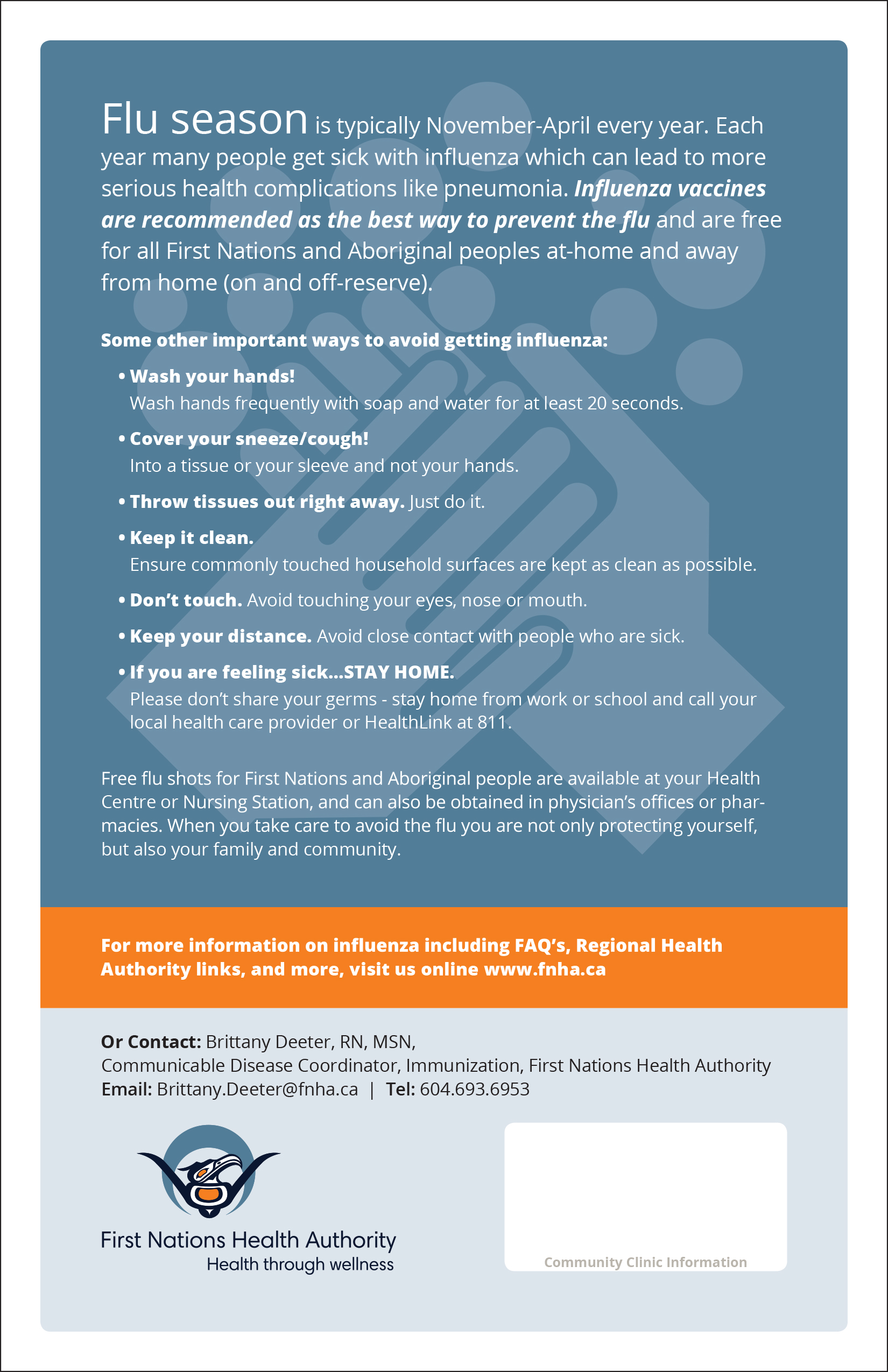
Flu season is typically November-April every year. Each year many people get sick with influenza which can lead to more serious health complications like pneumonia. Influenza vaccines are recommended as the best way to prevent the flu and are free for all First Nations and Aboriginal peoples at-home and away from home (on and off-reserve).
Download the FNHA Flu posters for tips and info:
FNHA Flu Poster letter size
FNHA Flu Poster tabloid size
Some other important ways to avoid getting influenza:
• Wash your hands! Wash hands frequently with soap and water for at least 20 seconds.
• Cover your sneeze/cough! Into a tissue or your sleeve and not your hands.
• Throw tissues out right away. Just do it.
• Keep it clean. Ensure commonly touched household surfaces are kept as clean as possible.
• Don't touch. Avoid touching your eyes, nose or mouth.
• Keep your distance. Avoid close contact with people who are sick.
• If you are feeling sick…STAY HOME. Please don't share your germs - stay home from work or school and call your local health care provider or HealthLink at 811.
Free flu shots for First Nations and Aboriginal people are available at your Health Centre or Nursing Station, and can also be obtained in physician's offices or pharmacies. When you take care to avoid the flu you are not only protecting yourself, but also your family and community.
For flu shot clinics throughout the province, visit the BC Flu Clinic Locator.
For more information on influenza including FAQ's, Regional Health Authority links, and more, visit us online: FNHA Influenza (Flu) Information.
Or Contact:
Brittany Deeter, RN, MSN
Communicable Disease Coordinator, Immunization
First Nations Health Authority
Brittany.Deeter@fnha.ca
Tel: 604.693.6953
Questions about the Influenza virus:
What is influenza?
Influenza, often called the flu, is an infection of the nose, throat and lungs caused by an influenza virus. Getting influenza makes you more likely to get other infections, like pneumonia. People most at risk of getting very sick from influenza are Elders 65 years and older, very young children, people who have lung or heart diseases, chronic health conditions, or weakened immune systems and pregnant women.
You can help keep yourself from getting infected with influenza by:
• Washing your hands often
• Throwing away used tissues right away
• Directing your cough or sneeze into your sleeve or elbow instead of your hand
• Staying home when you are sick
• Getting an a flu shot (influenza vaccine) every year
Influenza virus spreads easily when tiny drops from talking, a cough
orsneeze from one person are inhaled by another, or when a person touches something with drops on it and then touches their eyes, mouth or nose before washing their hands.
If you get infected with influenza you can spread it before you even feel sick. Adults can spread the virus from about 1 day before to 5 days after symptoms start. Young children may be able to spread the virus for an even longer time.
What are the symptoms?
Influenza symptoms can include fever, headache, muscle pain, runny nose, sore throat, extreme tiredness, and cough. Children may also experience an upset stomach, vomiting, or diarrhea. Symptoms of influenza tend to almost the same as those of colds, though those caused by the influenza virus tend to be worse. Influenza symptoms start about 2 days after a person comes into contact with droplets of the virus and they last between 1 to 2 weeks.
Reference: Is it influenza or a cold?
|
Symptoms |
Cold |
Influenza (the flu) |
| Fever | Rare | Usual, sudden onset 39º-40º, lasts 7 to 10 days |
| Headache | Rare | Usual, can be severe |
| Aches and Pains | Sometimes mild | Usual, often severe |
| Fatigue and weakness | Sometimes mild | Usual, may last 2-3 weeks or more |
| Extreme fatigue | Unusual | Usual, early onset, can be severe |
| Runny, stuffy nose | Common | Sometimes |
| Sneezing | Common | Sometimes |
| Sore throat | Common | Sometimes |
| Chest discomfort, coughing | Sometimes mild to moderate | Usual, can be severe |
| Complications | Can lead to sinus congestion or earache | Can lead to pneumonia, respiratory failure, and more complications in persons with chronic diseases |
| Prevention | Frequent hand-washing | Yearly influenza vaccine and frequent hand washing |
| Treatment | No specific treatment is available; symptom relief only | Anti-viral drugs by prescription, which can reduce symptoms
|
From the Ministry of Health:
http://www.healthlinkbc.ca/healthfiles/hfile12b.stm
Did You Know?
• An infected person can spread the influenza virus even before feeling sick.
• An adult can spread the virus from about 1 day before to 5 days after symptoms start.
• Young children may be able to spread the virus for a longer period of time.
• The Influenza virus is 'shed' by persons before they develop symptoms of influenza, and by persons who don't have any symptoms.
• A strong immune system can lessen severe complications of the flu.
Questions about the Influenza vaccine:
What is the influenza vaccine?
The influenza or flu vaccine is a safe and effective way to help people stay healthy, prevent illness, and save lives. The influenza virus can cause serious illness and even death in people, particularly Elders, the very young, pregnant women and those with certain chronic health conditions. The vaccine is the best protection against influenza illness and its complications.
Each year the vaccine is formulated to match what the World Health Organization and an advisory group of experts forecast will be the circulating strains that winter. Most vaccines used in the healthcare worker program in BC use killed virus and cannot cause infection – you cannot get influenza from getting your flu shot. The live attenuated influenza virus vaccine (which is given as a nasal spray) contains weakened influenza virus, which replicates in the nose only and will not cause influenza unless a person is severely immunocompromised.
The influenza vaccine protects against viruses that cause influenza. The vaccine does NOT protect against non-influenza viruses or bacteria that cause colds or gastrointestinal infections (sometimes called 'stomach flu'). Several different influenza vaccines are available in B.C. All of the vaccines are approved by Health Canada. In BC, the vaccine is usually available starting in mid‐October. For your best protection and that of health care professional patients and family, you should get the vaccine as soon as possible as it takes about two weeks for the vaccine to provide maximum protection against influenza viruses
Am I eligible for a free flu shot?
All First Nations and Aboriginal peoples at-home and away from home (on and off-reserve) are eligible to receive a free flu shot each influenza season.
What kinds of flu vaccines are available?
There are currently four different influenza (flu) vaccines which are publicly funded in BC, three vaccines are inactivated and one is a live attenuated vaccine. Vaccine availability varies by region within BC. A health care provider can help determine which influenza vaccine people are eligible for.
Inactivated influenza (flu) vaccine (the flu shot):
There are two standard inactivated influenza vaccines, which are made of killed and split influenza viruses, Agriflu® and Fluviral®. These are is approved for anyone 6 months and older. The inactivated influenza vaccine or flu shot is given by injection.
A third inactivated influenza vaccine, called Fluad® may be available in some areas. Like Agriflu® and Fluviral® this vaccine is made of killed and split influenza viruses, but it also contains an adjuvant, which is a substance added to a vaccine to help the body respond to the vaccine better. Fluad® is recommended for Elders (those 65 years of age and older), as they may not respond as strongly as younger people to the other inactivated vaccines.
Standard reactions to inactivated influenza vaccines are redness, soreness and swelling in the arm or leg where the vaccine was given. They can also cause mild flu-like symptoms (for example: fussiness, headache, muscle soreness and tiredness) for a couple of days after the vaccine is given.
Live attenuated influenza (flu) vaccine (the nasal spray): The live attenuated influenza vaccine, called Flumist® is made from weakened influenza viruses. It is given as a spray into the nose. In BC it is publicly funded for people 2-17 years of age. It is the preferred vaccine for children 2 to 8 years of age because it provides better protection in young children than the inactivated influenza vaccine, or flu shot, given by injection. Because this vaccine contains live weakened influenza virus it is not recommended for anyone with immune system problems, pregnant women or children before the age of 2.
The live attenuated influenza vaccine can cause cold-type symptoms (mild fever, runny nose, coughing) and is less effective in adults and teenagers but more effective in young children between the ages of 2-8 years. While vaccine virus shedding has been detected it has only rarely resulted in transmission. For this reason the only situation in which the live attenuated vaccine is not recommended for a healthy, non-pregnant person is if the client is a contact of a person so immunocompromised that they require protective hospitalization (for example, a person who has just had a bone marrow transplant). The shedding of the virus lasts about 2 weeks post vaccine.
Who should not get the inactivated influenza vaccine?
Speak with your health care provider if you:
• Had a life-threatening reaction to a previous dose of influenza vaccine, or any component of the vaccine (people with egg allergies can be safely immunized with the inactivated influenza vaccine)
• Had severe oculo-respiratory syndrome after a previous flu shot
Developed Guillain-Barré Syndrome (GBS) within 8 weeks of getting any influenza vaccine without another cause being identified
• Children less than 6 months of age should not get the flu shot because the vaccine is not known to be effective at this age
What are the possible reactions after the vaccine?
Common reactions to the influenza vaccine or flu shot include soreness, redness and swelling where the vaccine was given. Other symptoms can include fever, headache, aching muscles and fatigue that may last 1 to 2 days.
The nasal spray vaccine (live attenuated influenza vaccine) can cause cold-type symptoms such as mild fever, runny nose, coughing for a couple of days after the vaccine is given.
Any more serious reactions are unusual and need to be reported to your physician. Although allergic reactions can be serious they are rare. The health care provider has medication to treat allergic reactions and this is the reason that you have to stay nearby for 15 minutes following any immunization.
The influenza vaccine given by needle cannot give you influenza. The vaccines available in the healthcare worker program contain only part of the influenza viruses and cannot cause infection. Acetaminophen or Tylenol® can be taken for fever or soreness. ASA or Aspirin® should NOT be taken by anyone under 20 years of age due to the risk of Reye Syndrome.
What are the Side Effects?
Inactivated influenza vaccine (given by injection): Common reactions to the influenza vaccine or flu shot include soreness, redness and swelling where the vaccine was given. Other symptoms can include fever, headache, aching muscles and fatigue that may last 1 to 2 days. Any more serious reactions are unusual and need to be reported to your physician. Serious allergic reactions (called anaphylaxis) are rare, happening to approximately one in a million people who get the influenza vaccine. The health care provider has medication to treat allergic reactions and this is the reason that you have to stay nearby for 15 minutes following any immunization.
What are the flu strains in this year's vaccines?
The 2014/15 seasonal trivalent influenza vaccines contain the following strains:
• A/California/7/2009 (H1N1)pdm09-like virus
• A/Texas/50/2012 (H3N2)-like virus
• B/Massachusetts/2/2012-like virus
Strains are unchanged from the 2013-14 influenza season.
Don't Let the Flu Get To You!
The peak of the influenza season is traditionally November to April. During the influenza season, all First Nations and Aboriginal people in BC are eligible to receive the influenza vaccine free of charge. The vaccine is available through your local health centre or nursing station, pharmacist, or your family doctor. The influenza vaccine along with good personal hygiene, including good hand washing is the best defense against contracting and spreading the influenza virus. If you do find yourself sick with influenza you can help protect others from getting ill; stay home and rest, drink plenty of fluids and manage your symptoms.
The flu: don't pass it on!
Each year in Canada up to 7 million Canadians get the flu. Flu is very contagious and can spread quickly and easily. You can pass the flu on to others who may be at risk of serious complications. By getting the flu vaccine, you protect yourself and others because you are less likely to spread the flu.
If you have any questions about the influenza please visit us online:
http://www.fnha.ca/what-we-do/communicable-disease-control/influenza-information
or contact our Health Protection Unit at:
Brittany Deeter
Communicable Disease Coordinator, Immunization
First Nations Health Authority
Brittany.Deeter@fnha.ca
Tel: 604.693.6953
View our Regional Health Authority Partner Influenza (flu) information pages for more information in your region:
Facts about the Flu - Health Link BC
BC CDC: www.bccdc.ca/imm-vac/VaccinesBC/Influenza/default.htm
Immunize BC: www.immunizebc.ca/
Vancouver Coastal Health: www.vch.ca/your_health/health_topics/communicable_diseases/influenza/
Island Health: www.viha.ca/flu/
Fraser Health Authority: www.fraserhealth.ca/your_health/immunizations/flu_shots/
Northern Health Authority: www.northernhealth.ca/YourHealth/PublicHealth/InfluenzaInformation.aspx
Interior Health Authority: www.interiorhealth.ca/YourHealth/Immunization/SeasonalFluCampaign/Pages/default.aspx
www.fightflu.ca