For Immediate Release
Unceded territories of the xʷməθkʷəy̓əm (Musqueam), Sḵwx̱wú7mesh (Squamish) and səlilwətaɬ (Tsleil-Waututh) Nations | VANCOUVER – The 2025 First Nations specific toxic drug deaths and event data released by First Nations Health Authority (FNHA), illustrates an encouraging decrease in toxic drug deaths and events compared to 2024; however, it also reveals that First Nations people continue to be overrepresented in the data 10 years after the toxic drug public health emergency was declared in BC.
The data illustrates the continued disparity between First Nations and non-First Nations people in BC. While First Nations people represent 3.4% of BC's population, in 2025, they represented 15.8% of toxic drug poisoning deaths. Since 2016, 2,836 First Nations people have lost their lives due to toxic drug poisonings.
In 2025, 289 First Nations people across BC died from toxic drug poisonings — a 33.3 per cent decrease from the 433 who died in 2024. The data also shows a 17 per cent decrease in toxic drug poisoning events overall with a total of 2,924 compared to 3,523 events experienced by First Nations people in BC in 2024. This trend indicates that harm reduction efforts continue to be effective methods to prevent deaths due to toxic substances.
“Since 2016, the toxic drug public health emergency has changed the lives of many and continues to disproportionately affect First Nations communities across British Columbia," said Dr. Nel Wieman, Chief Medical Officer, FNHA. “I must acknowledge the positive impact of First Nations-led harm reduction efforts. The data shows that lives are saved through connection and culture and when programs and services are community-led. FNHA will continue to provide culturally safe harm reduction supports, as we walk hand in hand with First Nations people through this crisis."
While the data illustrates hopeful downward trends related to toxic drug poisonings and deaths, it also reveals that younger First Nations people continue to be impacted by the public health emergency. In 2025, 49.5% of First Nations toxic drug poisoning deaths were among those younger than 40 years old, while 62.9% of First Nations drug poisoning events in 2025 were among those younger than 40 years old.
FNHA responds to the unique needs of First Nations communities across BC. FNHA's Framework for Action is our system-wide approach that is focused on preventing deaths while also supporting First Nations people on their healing journeys.
“We know that culture is powerful medicine, and that part of addressing the toxic drug public health emergency is providing individuals with opportunities to connect or reconnect with culture, and that cultural ways of knowing and healing must be embedded across the continuum of care" said Celeta Cook, Executive Director, Public Health Response and Primary Care at FNHA. “FNHA approaches substance use as a health issue, and we know that response efforts grounded in harm reduction, cultural safety, self-determination, and First Nations perspectives on health and wellness saves lives."
FNHA will continue to work in partnership with First Nations communities, Chiefs, health leaders, peer workers, health-care frontline staff and other provincial partners in response to this emergency with support that is effective, culturally safe and culturally grounded.
Learn More:
FNHA's “Increase the Support. Reduce the Harm." video series features Indigenous people talking about harm reduction and the impact of toxic drugs in their lives and the lives of their loved ones.
FNHA published the With Open Arms toolkit, to support First Nations youth to have courageous and compassionate conversations about substance use. Resources for the campaign, including a new toolkit titled 'With Open Arms: Supportive Conversations Among Friends,' are intended to address the need for accessible information on substance use prevention, harm reduction, wholistic wellness and keeping friends close in conversations about substance use.
Key aspects of harm reduction for First Nations people in BC include relational practice, wholistic health, drawing on the ancestral strengths of culture, community, and kinship and respecting an individual's needs, priorities, and autonomy in their healing journey.
FNHA encourages First Nations people to learn more about the FNHA Healing Indigenous Hearts facilitators' guidebook, which is a resource for those wishing to establish peer groups to support Indigenous peoples and families that are navigating grief and loss related to the harms from substance use.
A Framework for Action: Responding to the toxic drug crisis for First Nations captures a system- wide response to slow and stop toxic drug deaths. The Framework for Action is focused on the most urgent goal of preventing deaths while also supporting First Nations people on their healing journeys.
BACKGROUNDERA deeper look at the data
Toxic Drug Poisoning Deaths
Although a decrease in the number of First Nations toxic drug deaths inspires hope after several years of significant and devastating increases, the First Nations death rate in 2025 was still 5.4 times higher than the rate of death among other BC residents in 2025. This has been an ongoing trend since the toxic drug crisis was declared a public health emergency in 2016.
This means that while both populations saw a decrease in toxic drug deaths in 2025, the decrease among First Nations deaths was smaller than the decrease seen in other residents of BC, confirming that First Nations people continue to be disproportionately impacted by the toxic drug crisis.
While First Nations people make up 3.4 per cent of BC's population, they represent 15.8 per cent of toxic drug poisoning deaths in 2025.
Toxic Drug Poisoning Deaths by Sex
Our data is limited to biological sex at birth, which may misidentify two-spirit, transgender, non-binary, intersex and gender diverse people. Health Surveillance data is dynamic and subject to change with new information and historical corrections.
In 2025:
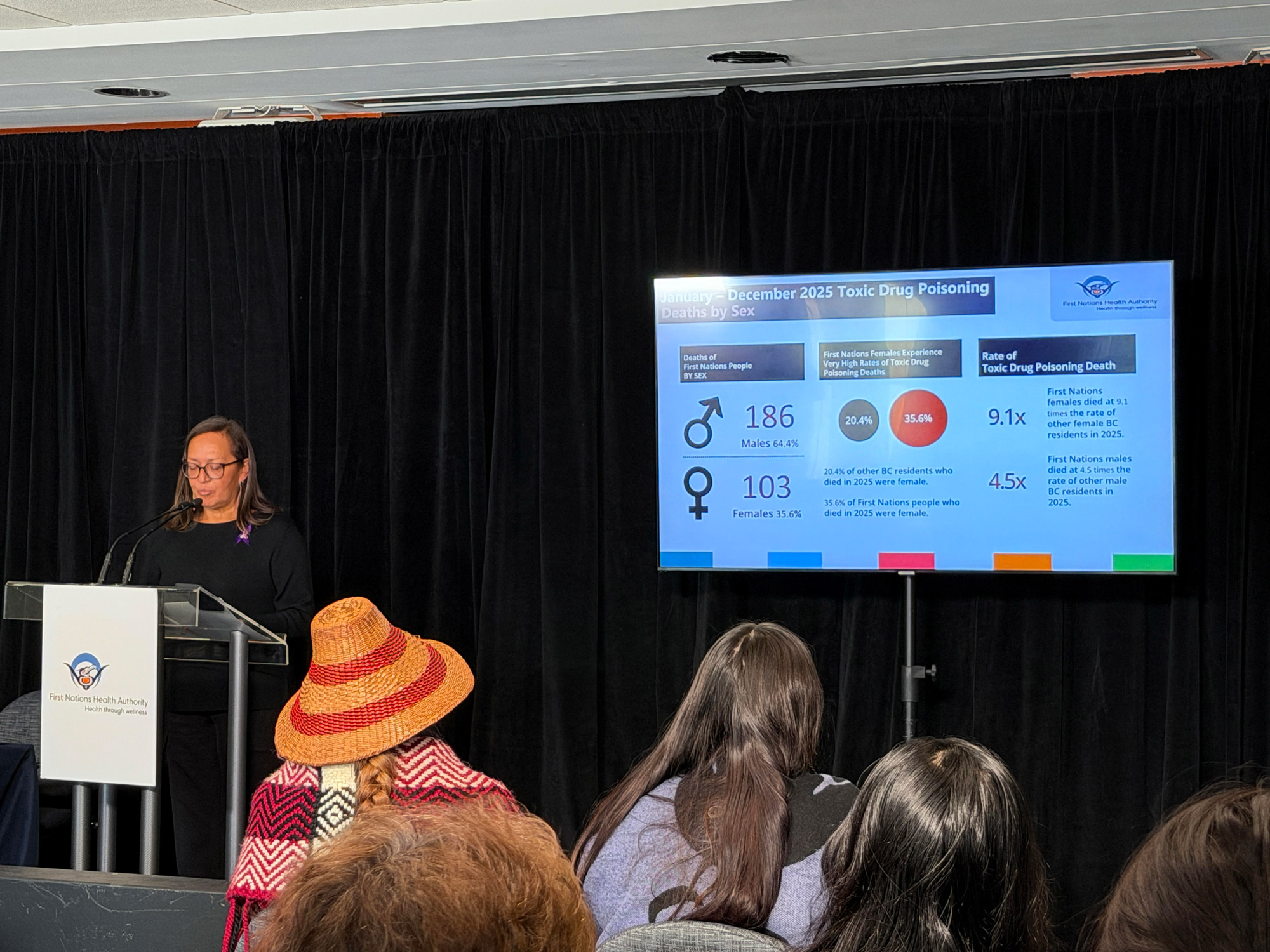
- 64.4% of the 289 First Nations deaths were among males,
- 35.6% of First Nations people who died in 2025 were female. This compares to 20.4% of other BC residents who died in 2025 being female.
- First Nations females are still disproportionately impacted by this emergency and died at 9.1x the rate of other female residents in 2025.
- First Nations males died at 4.5 times the rate of other male residents in 2025.
Toxic Drug Poisoning Events In BC
In BC in 2025:
- 2,924 toxic drug poisoning events across BC were experienced by First Nations, compared to 3,523 events in 2024, representing a 17% decrease.
- 62% of these events were among males, and 38% were among females.
Toxic Drug Poisoning Deaths and Events by Age
The data shows that younger people are the most affected by this crisis:
- 49.5% of First Nations toxic drug poisoning deaths in 2025 were experienced by people younger than 40 years old.
- 62.9% of First Nations drug poisoning events in 2025 were experienced by people younger than 40 years old