Health Leads and Chiefs ask for increased focus on community-led solutions
Clockwise from top left: Frank Hanuse "Fug" of Wuikinuxv First Nation, Dan Smith of Wuikinuxv First Nation, Paul Willie of Dzawada̱ʼenux̱w First Nation (Kingcome) representing Wuikinuxv First Nation; Debbie Alendal of Lil'wat First Nation and Florence Ward, Lil'wat, Family Support and from N'Quatqua; Geneva Quipp - Skatin Nation Administrator, Gabe Williams of Skatin First Nation, Loretta Stager of Xa'xtsa First Nation and Douglas First Nation Administrator
Chiefs and health leads gathered in the shared territory of Musqueam, Squamish and Tsleil-Waututh First Nations from November 28 to 30 to discuss health and wellness programming and service improvements at the 2017 Vancouver Coastal Caucus session.
Long-time First Nations Health Council representative Ernest Armann chaired the dialogue-rich event with spirit and humour, while keeping the proceedings engaging and on track.
Five Chiefs and 11 proxies, 11 health leads, and 14 technical leads participated in the three day caucus session, along with more than 20 Traditional Knowledge Keepers, cultural drumming groups, and wellness practitioners. Twelve of the 14 Vancouver Coastal communities were represented at Caucus.
The theme of culture was integral to the VC caucus. Traditional Knowledge Keepers from each sub-regional family infused Caucus with prayer and ceremony at the start, middle and end of each day.
Clockwise from top left: Coast Salish Wolf Pack; Vancouver Coastal Region's Southern Stl'atl'imx representatives - Councilor Joshua Anderson, Lil'wat; Joanne John, A/Health Director Lil'wat Health and Healing; and Chief William Schneider, Samahquam; Coast Salish Wolf Pack; and Terry Reid, Traditional Knowledge Keeper from the Central Coast
Shane Pointe, Traditional Knowledge Keeper from Musqueam Nation, opened the Fall Caucus session by asking people to hold hands as he led the group in a song. "You are medicine," Shane told the group. "The work that we do in health and wellness today will affect future generations."
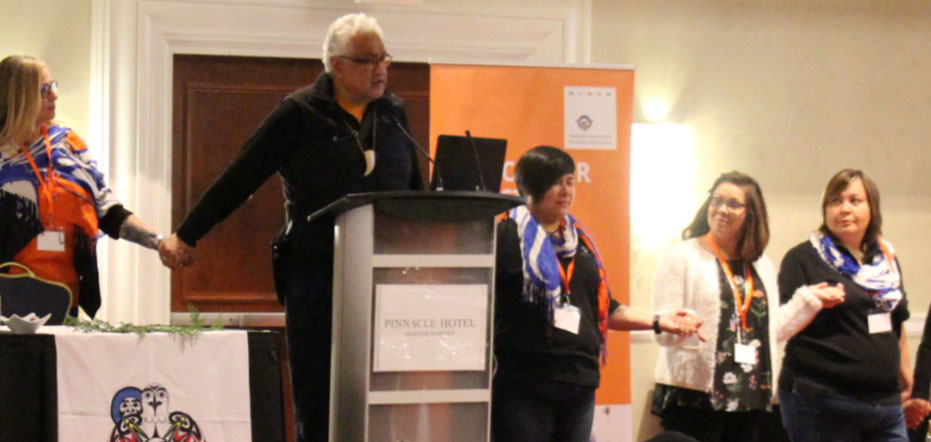
Shane Pointe, Traditional Knowledge Keeper from Musqueam Nation
Vancouver Coastal regional update: "Progress toward achieving our Goals"
Naomi Williams, A/Regional Director for Vancouver Coastal Region, shared that the work of the Vancouver Coastal Region family continues to stay focused on redefining the Regional Health and Wellness Plan priorities and goals, while also re-designing health systems so they are more closely linked to community. Naomi emphasized that the VC regional family continues to move together towards transforming services as one family, while balancing the needs of each of the fourteen VC communities' unique cultures, traditions, and geography.
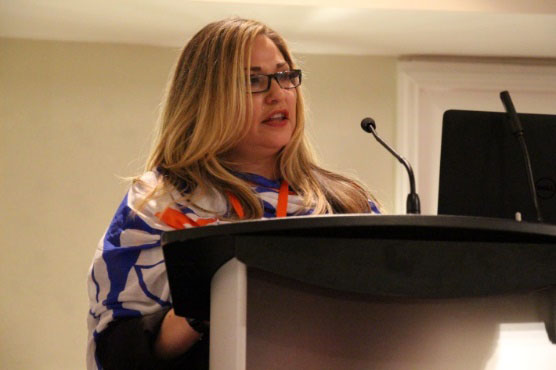
Naomi Williams, A/Regional Director, FNHA Vancouver Coastal Region
FNHA services and programs
Three FNHA executives updated delegates on several FNHA services. All three presenters emphasized ongoing improvements to services moving forward.
Darren McKnight, Director, Health Benefits Management, explained that transitioning to Plan W for pharmacy coverage was a first step; the next step is transitioning other benefit areas (such as dental and vision benefits) so that First Nations have a stronger voice on the coverage they need.
Dr. Shannon McDonald, Deputy Chief Medical Officer, spoke about harm reduction and the need to open our minds to alternatives to abstinence. "We need to embed harm reduction within the continuum of services — a continuum which includes abstinence but is not exclusive to that. Small gains are better than no gains … and we keep loved ones alive," said Dr. McDonald.
Sonia Isaac-Mann, VP, Programs, Services, Research & Knowledge Exchange presented on Jordan's Principle and the upcoming Mental Health and Wellness Summit, among other topics.
Mental Health and Wellness Polling
FNHA used text-based technology to poll delegates on issues related to mental health and wellness. Polling revealed:
• 39 percent of respondents use the term "Harm Reduction" in their communities
• 68 percent of respondents agree with the Harm Reduction Policy Statement Vision
• 64 percent of respondents agree with the Mental Health and Wellness and Substance Use Statement Vision
• 50 percent of respondents said they would like to see "traditional healing and wellness approaches as a foundation" as their top mental health and wellness priority
The Ten-Year Social Determinants of Health Strategy
Grand Chief Doug Kelly presented a discussion paper on the social determinants of health, where he emphasized the need for rebuilding.
"We need to undo the damage of 150 years of colonization, the Indian Act, residential schools and more. When I think about the social determinants of health, I think 'what is it going to take to rebuild each and every First Nations person in BC one by one? What's it going to take to rebuild our families, our communities, our nations? This is the challenge and the opportunity with the social determinants — it's in the rebuilding," said Kelly.
Doug Kelly also touched on the serious problems with program design and decision-making, voicing that programs developed by federal and provincial governments do not provide communities with the flexibility they need to design the services that will best serve First Nations children and families.
Doug Kelly assured delegates that the First Nations Health Council (FNHC) is advocating on their behalf to move away from the contribution agreement/program model and to work towards a transfer agreement model, like the federal government has with the provinces. "The transfer payments would go from Ottawa to the Nation. This is the Nation to Nation approach."
Promising and Innovative Practices
Rory Housty and Larry Jorgensen spoke about Koeye Camp at Heiltsuk First Nation, which takes a land-based approach to youth and wellness. Both have been involved with the camp for decades. Larry spearheaded the creation of the youth camp over twenty years ago; Rory participated as a camper every summer of his childhood and now works as a camp leader. Koeye Camp is grounded in First Nations culture, language, traditional teachings and environmental stewardship.
One of the innovative aspects of the camp is that it run using a non-profit organization model. Also, it owns land it operates on and has formed a conservancy to protect this land. The non-profit organization, Qqs Projects Society, receives no government funding. Instead, it is funded by donations from organizations across BC and even around the world.
Delegates were quite interested in the generational sustainability and overall success experienced by experimenting with this unique approach. Dean Nelson, Political Chief of Líl̓wat First Nation, asked "What is the main factor that led to this positive outcome?" The key was full support from Elders in the community and the flexibility provided by not needing to compete with the community for funding due to the project's non-profit model.
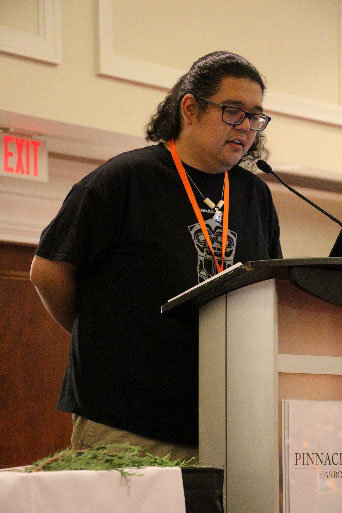
Rory Housty, Leader at Koeye Camp at Heiltsuk First Nation
Opening up dialogue with ministry partners
Leaders from the Ministry of Child and Family Development (MCFD), Indigenous Northern Affairs (INAC), and the Ministry of Mental Health and Addictions (MMHA) presented updates on service models and communicated their commitment to improved engagement with VC First Nations'.
Ministry partners were unified in their openness to discussing moving towards a reciprocal partnership-based relationship, starting with listening to community voices.
This day was rich in dialogue, as numerous delegates addressed guest presenters at the mic with their comments and concerns — many heartfelt experiences and perspectives were shared.
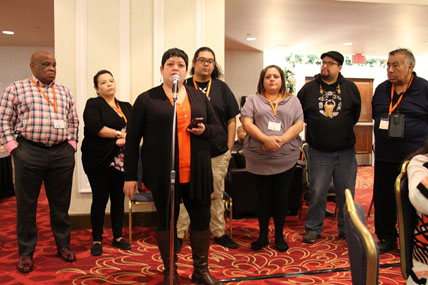
Chief Pamela Wilson of Heiltsuk First Nation
The overwhelming consensus among delegates was clear: each Nation is in the best position to make decisions for the health and wellness of its people, especially with the geographic challenges and culturally-rich diversity of the Vancouver Coastal Region Nations.
There was also much agreement among chiefs and health leads on how essential it is to provide more expertise, services and resources directly in community in order to minimize the need to leave community to receive essential services.
Lively discussion about a Nation to Nation approach
Several delegates broached the topic of Nation to Nation engagement and what it meant to government to work in reciprocal partnership instead of a status quo of unilateral reform. Chief William Schneider of Samahquam First Nation asked the ministry presenters to reflect on engaging Nation to Nation and what this concept meant for those working in government.
Dan Smith, Tribal Manager of Wuikinuxv First Nation, echoed Will Schneider's sentiments by asking "How are you going to change things in the system so that you can rewrite some of these policies and ensure each Nation is involved in those changes? We need champions within government to initiate this change."
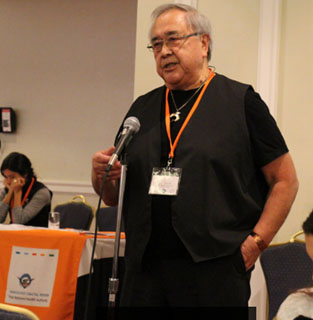
Dan Smith, Tribal Manager of Wuikinuxv First Nation
INAC leader Catherine Lappe concurred that "Government needs to move towards reconciliation in the way that First Nation communities want to — without a predetermined government agenda." MCFD official Denise Devenny agreed that champions of change within government for First Nations rights was necessary.
Emergency Management Overview
An emergency management panel, consisting of Emergency Management BC's Monica Cox, INAC's Jodie Kayden and FNHA's Casey Neathway, presented on the wildfire emergency of 2017. The panelists discussed lessons learned and how to make improvements moving forward.
Text polling during the panel revealed:
• 70 percent of respondents felt their communities were not aware of available resources for emergency planning
• 81 percent of respondents felt their communities did not have access to adequate resources for emergency planning
Supporting mental health, children and youth
Robert Lampard and Martin Bartel of MCFD presented on child and youth mental health, followed by a presentation about early years services by Corrine Sagmeister and Emily Horton from the Provincial Office of the Early Years.
All presenters shared their commitment to building prevention into the new frameworks, prioritizing a First Nations perspective within services, and creating local solutions. They proposed working on two parallel tracks for now: (1.) Investing in service gaps today, and (2.) Working together with communities to integrate services for the future.
Doris Peters, Chief and Council for N'Quatqua First Nation and Child and Youth Clinician for VCH, shared the realities of working in a counselling capacity with Aboriginal youth and families. "The Aboriginal community needs greater access to all services. We have more need, more acuity … much more complexity," she explained.
Doris Peters noted that the current policies do not recognize the time clinicians spend doing critical relational and collaborative work, such as time on the phone with client's social workers and the ministries. The current framework only measure clinical hours, which is only part of the support clients need. "We need to look at this in a different way."
First Nations Health Directors Update
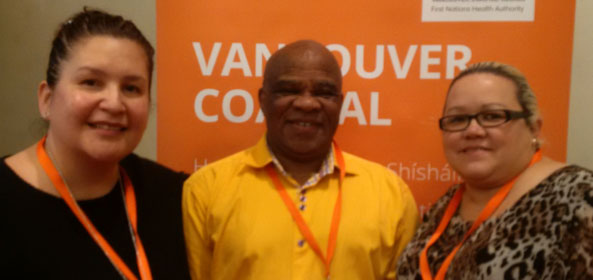
FNHDA President Kim Brooks, Board Member Keith Marshall, and newly-elected FNHDA Board Member Rosemary StagerThe Vancouver Coastal Caucus finished up with an update from the First Nations Health Directors Association (FNHDA) presented by Kim Brooks, FNHDA President and Board Member Keith Marshall, Health Director for Heiltsuk First Nation. They presented on a new health director certification program that is in development, FNHDA's work on lateral kindness, the New Societies Act, and they welcomed to the Board newly-elected FNHDA representative Rosemary Stager, Health Director for South Stl'atl'imx First Nation.